God the Craftsman: What the Hebrew Actually Says About Divine Action
God the Craftsman: What the Hebrew Actually Says About Divine Action
The Problem with “Hardened”
Most English-speaking Christians have encountered a theological puzzle in Exodus: God “hardened Pharaoh’s heart.” On the surface, this seems to implicate God in directly controlling Pharaoh — overriding his agency and compelling him toward evil. But this reading is an artifact of translation, not a feature of the original text.
The Hebrew narrative uses three distinct verbs, all of which the King James Version flattens into the single English word “hardened.”
חָזַק (chazaq) — Strong’s H2388. To strengthen, make firm, make courageous. This is the same root used in Joshua 1:6: “Be strong (chazaq) and of good courage.” The word carries no inherent connotation of evil or stubbornness. It means to fortify resolve.
כָּבֵד (kaved) — Strong’s H3513. To be heavy, weighty. This is the same root as כָּבוֹד (kavod), meaning glory or weight. Applied to the heart, it conveys sluggishness and unresponsiveness — a heart weighed down and unmoved.
קָשָׁה (qashah) — Strong’s H7185. To be hard, severe, stiff. This is closest to the English sense of “hardened,” but it appears least frequently in the Pharaoh narrative (Exodus 7:3 is the main instance).
The Sequence Matters
In the early plagues (roughly plagues 1–5), the text predominantly says Pharaoh hardened his own heart, using kaved — he made his own heart heavy, sluggish, unresponsive. Exodus 8:15 (8:11 in Hebrew numbering): Pharaoh hikkbid (made heavy) his own heart. Exodus 8:32 repeats this pattern. Pharaoh is the agent acting on himself.
In the later plagues (roughly plagues 6 onward), the text shifts to God as subject, predominantly using chazaq — God strengthened Pharaoh’s heart. Exodus 9:12: “The LORD chizzaq (strengthened) Pharaoh’s heart.”
The trajectory is clear: Pharaoh repeatedly chose heaviness and unresponsiveness on his own, and then God strengthened that existing resolve.
What “God Strengthened” Actually Means
When the text says God chazaq’d Pharaoh’s heart, the Hebrew supports a reading closer to: “God gave Pharaoh the strength to follow through on what Pharaoh had already chosen.” Not “God overrode Pharaoh’s will and forced him toward evil.”
This matters because chazaq is used overwhelmingly as a positive word in the Hebrew Bible — strengthening, encouraging, fortifying. God did to Pharaoh what God does to Joshua: gave him the firmness to act on his existing commitments. The difference is that Joshua’s commitments were righteous and Pharaoh’s were not.
The Idiom of Permission
There is a broader pattern at work here. Hebrew frequently attributes to God things He permits or creates conditions for rather than directly causes. This is sometimes called the idiom of permission — the Hebrew mind tended to trace all events back to God’s sovereignty, so “God did X” could idiomatically mean “God allowed X to happen” or “God created the circumstances under which X occurred.”
This shows up elsewhere in the Old Testament. When 2 Samuel 24:1 says “the LORD moved David” to number Israel, the parallel account in 1 Chronicles 21:1 says “Satan stood up against Israel, and provoked David.” Same event, but the Hebrew writers could attribute it to God (ultimate cause and permission) or to the adversary (proximate cause) without seeing a contradiction.
Genesis 50:20: God the Weaver
The same pattern of divine action appears in one of the most theologically rich verses in Genesis. Joseph, speaking to the brothers who sold him into slavery, says:
“But as for you, ye thought evil against me; but God meant it unto good, to bring to pass, as it is this day, to save much people alive.” (KJV)
The problem word is “meant.” In English, “God meant it unto good” sounds like God intended the evil from the start — as though the brothers’ betrayal was God’s premeditated plan.
The Hebrew
וְאַתֶּם חֲשַׁבְתֶּם עָלַי רָעָה אֱלֹהִים חֲשָׁבָהּ לְטֹבָה
The critical observation: the verb חָשַׁב (chashav) — Strong’s H2803 — appears twice. Once for the brothers, once for God. Same verb, different prepositions.
Chashav does not primarily mean “to intend” or “to mean.” It means to weave, to design, to reckon, to account, to devise skillfully. This is confirmed by its usage elsewhere: chashav is the same root used for the master craftsmen of the tabernacle. Exodus 35:32 — “to devise (chashav) artistic works, to work in gold and silver and bronze.” A חֹשֵׁב (choshev) is a skilled weaver or designer. The word carries connotations of taking raw material and working it into something purposeful.
The Preposition Shift
The brothers: חֲשַׁבְתֶּם עָלַי רָעָה — devised against me (עָלַי / alai) evil.
God: חֲשָׁבָהּ לְטֹבָה — wove it toward (לְ / l’) good.
Same verb. Different directional preposition. The brothers took the raw material of the situation and designed it against Joseph for harm. God took the same raw material and wove it toward good.
What Joseph Is Actually Saying
A more transparent rendering would be:
“You wove against me for evil; God wove the same thing toward good — in order to accomplish, as you see today, the preservation of many lives.”
God didn’t intend the evil. God didn’t plan the betrayal. God took what the brothers freely chose — their agency fully intact — and wove it into a different pattern. The same raw events, reckoned toward a different outcome.
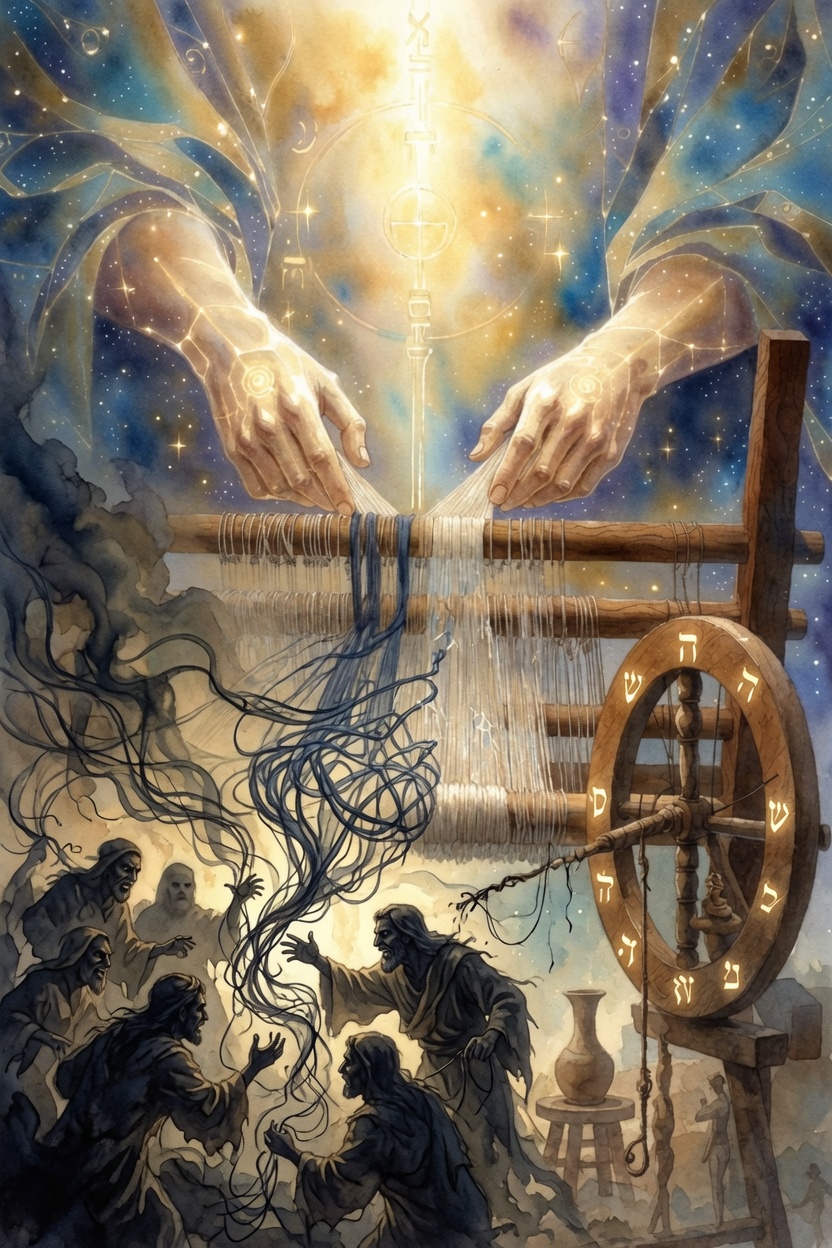
This is a craftsman word. God is the master weaver who takes the threads the brothers threw in malice and works them into a design they couldn’t see.
Creation as Craftsmanship, Not Conjuring
This pattern — God working with existing material rather than conjuring from nothing — extends to the most fundamental question in theology: the nature of creation itself.
The Creation Verbs of Genesis 1–2
Three primary verbs describe God’s creative acts:
בָּרָא (bara) — Strong’s H1254. Usually translated “create.” This is the word ex nihilo proponents lean on hardest, arguing it is reserved for divine action and implies something unprecedented. But bara’s semantic range includes cutting, shaping, and carving. It is used for clearing a forest in Joshua 17:18. The word itself does not demand “from nothing” — that reading is imported from later Greek philosophical theology, not extracted from the Hebrew.
יָצַר (yatsar) — Strong’s H3335. To form, to shape. This is explicitly a potter word. Genesis 2:7: God yatsar’d man from the dust of the ground. A potter does not conjure clay from nothing. A potter takes existing material and shapes it with skill and intention.
עָשָׂה (asah) — Strong’s H6213. To make, fashion, accomplish. This is workman language — constructing, building, assembling from available resources.
Across Genesis 1–2, the vocabulary is consistently: shape, form, fashion, make. Artisan language throughout.
Genesis 1:2 Is the Strongest Evidence
תֹהוּ וָבֹהוּ (tohu va’vohu) — “without form, and void.”
This description appears in verse 2, before God begins any creative acts. The material already exists. It is chaotic, disordered, unorganized — but it is present. God’s work beginning in verse 3 is imposing order on pre-existing substrate.
If creation were truly ex nihilo, verse 2 should not exist. You would go from nothing directly to God speaking things into being. Instead, you get a description of pre-existing chaos that God then organizes. The text itself presents the raw material as given, not generated.
Where Ex Nihilo Actually Comes From
The ex nihilo doctrine does not really enter Jewish or Christian theology firmly until the second century, primarily through engagement with Greek philosophy — particularly the Platonic and Neo-Platonic traditions. The early Genesis text simply was not asking the question in those terms.
The honest claim is not “Hebrew proves ex nihilo is wrong.” The honest claim is: the Hebrew text never teaches ex nihilo, the vocabulary consistently points toward organization of existing material, and ex nihilo was a later philosophical import.
A Consistent Picture of God
What emerges across these three texts is a remarkably consistent Hebrew portrait of how God operates:
With Pharaoh: God strengthened (chazaq) existing resolve that Pharaoh himself had chosen.
With Joseph’s brothers: God wove (chashav) existing events — freely chosen by human agents — toward a purposeful outcome.
With creation: God shaped (yatsar), made (asah), and organized (bara) existing material into ordered reality.
God does not override agency. God does not conjure from nothing. God does not orchestrate evil.
God is the master craftsman who works with what exists — strengthening resolve, weaving events, shaping matter — and brings it toward purposes that the raw material alone could never achieve.
Like a blacksmith reheating and reshaping metal that already exists. Like a potter forming clay that was already on the wheel. Like a weaver taking threads thrown in every direction and working them into a coherent, purposeful tapestry.
The Hebrew has been saying this all along. The English just hasn’t been listening.